
PELLA: Platform for Electron- and Laser-enabled Laboratory Astrophysics
The Frontier: Laboratory Astrophyics
From the vast expanse between galaxies to the hearts of stars, the universe is dominated by plasma—a sea of charged particles. Much of this cosmic plasma is far from the quiet equilibrium of a textbook example. Instead, it is a chaotic environment where the motions of particles are “organized” or “anisotropic,” leading to a host of so-called kinetic instabilities. These instabilities can lead to redistribution of energy by spontaneously generating magnetic fields from nothing, driving turbulence, and shaping the evolution of astrophysical objects.
For decades, studying these instabilities in a controlled laboratory setting has been a monumental challenge. How do you create a plasma where you know its precise state at the moment of its birth? And how do you watch what happens in the first few trillionths of a second as it evolves? This was the central challenge we aimed to solve.
The Platform
In this work, we developed and demonstrated the Platform for Electron- and Laser-enabled Laboratory Astrophysics (PELLA) for studying kinetic instabilities on their natural, ultrafast timescales. The key to our platform is Optical-Field Ionization (OFI). By using an intense, ultrashort laser pulse to ionize a gas (e.g., helium, hydrogen, etc.), we can create a plasma whose initial electron velocity distribution function (EVDF) is precisely known and highly anisotropic—perfectly primed for instabilities.
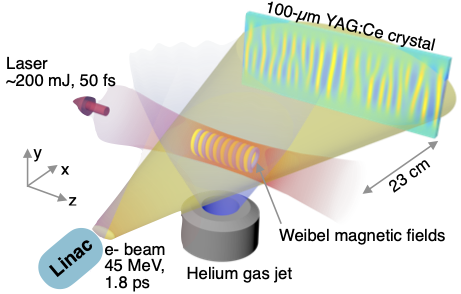
Fig. 1: The experimental platform, which combines intense lasers for plasma creation with advanced optical (e.g., Thomson scattering, not shown here) and electron beam diagnostics.
This OFI plasma becomes a miniature laboratory for astrophysics. Immediately following ionization, a hierarchy of instabilities begins to compete, each striving to bring the plasma to a more stable state. Our platform is uniquely equipped with synchronized, femtosecond-resolution diagnostics—including both Thomson scattering for electric fields and relativistic electron probes for electric- and/or magnetic fields—that allow us to watch this drama unfold in real time.
Observing a Hierarchy of Instabilities
Our experiments have captured a clear sequence of events. In the first few hundred femtoseconds, the highly non-thermal electron motion drives electrostatic waves associated with the two-stream instability, and magnetic fields associated with the current filamentation instability, as different streams of electrons collide and penetrate each other.
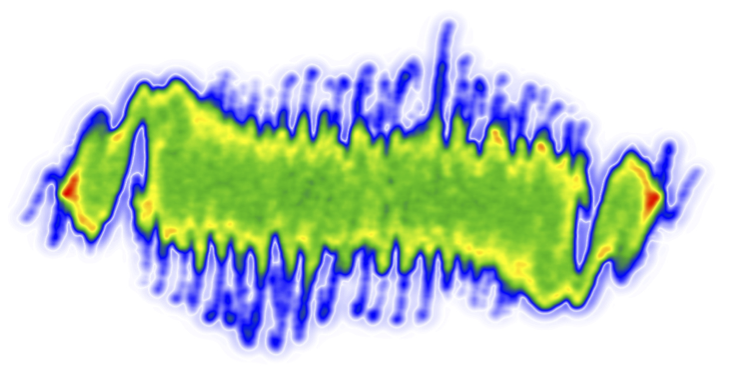
Fig. 2: A snapshot of the phase space of electrons obtained from PIC simulation that highlihgts the developing of the two-stream instability in the plasma.
On a slightly longer timescale of picoseconds, as the plasma has become closer to thermal state in each direction but still carries a large anisotropy (neaming the temeperatures differ in orthogonal directions), a different and profoundly important process takes over: the Weibel instability, which spontaneously creates magnetic fields. This instability efficiently converts the kinetic energy of the electrons into microscopic magnetic fields. We have produced the first-ever time-resolved maps of these self-generated magnetic fields, watching as they emerge from noise, grow into organized filamentary structures, and saturate.
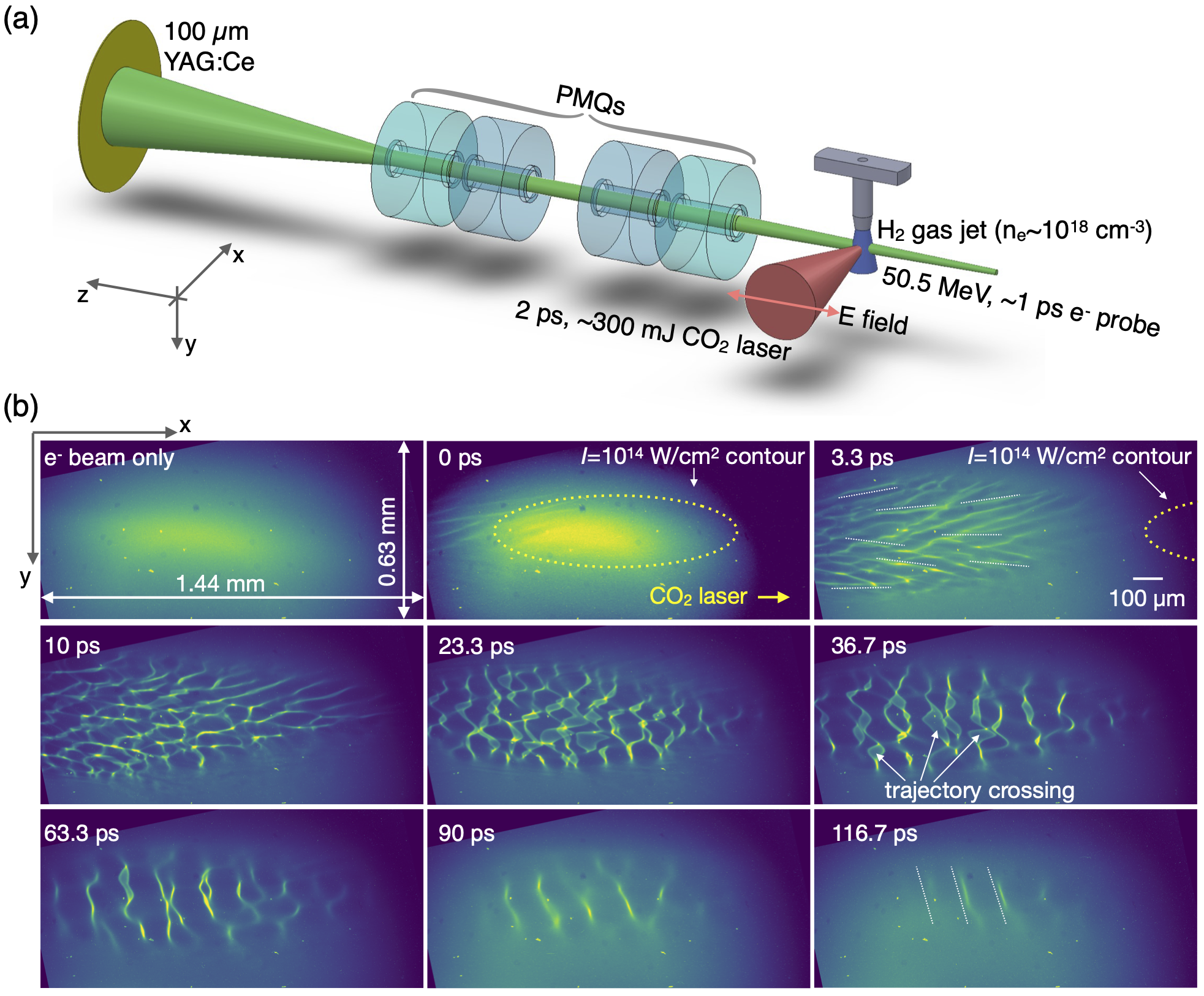
Fig. 3: Time-resolved 2D maps of the magnetic field generated by the Weibel instability, captured using the relativistic electron probe from a linear accelerator.
Furthermore, our long-term observations show that these magnetic structures are remarkably stable, persisting for undreds of picoseconds—a very long time in the plasma world. This longevity suggests that Weibel-generated fields could be a viable source for the “seed” magnetic fields required by dynamo theories to explain the magnetization of the universe.
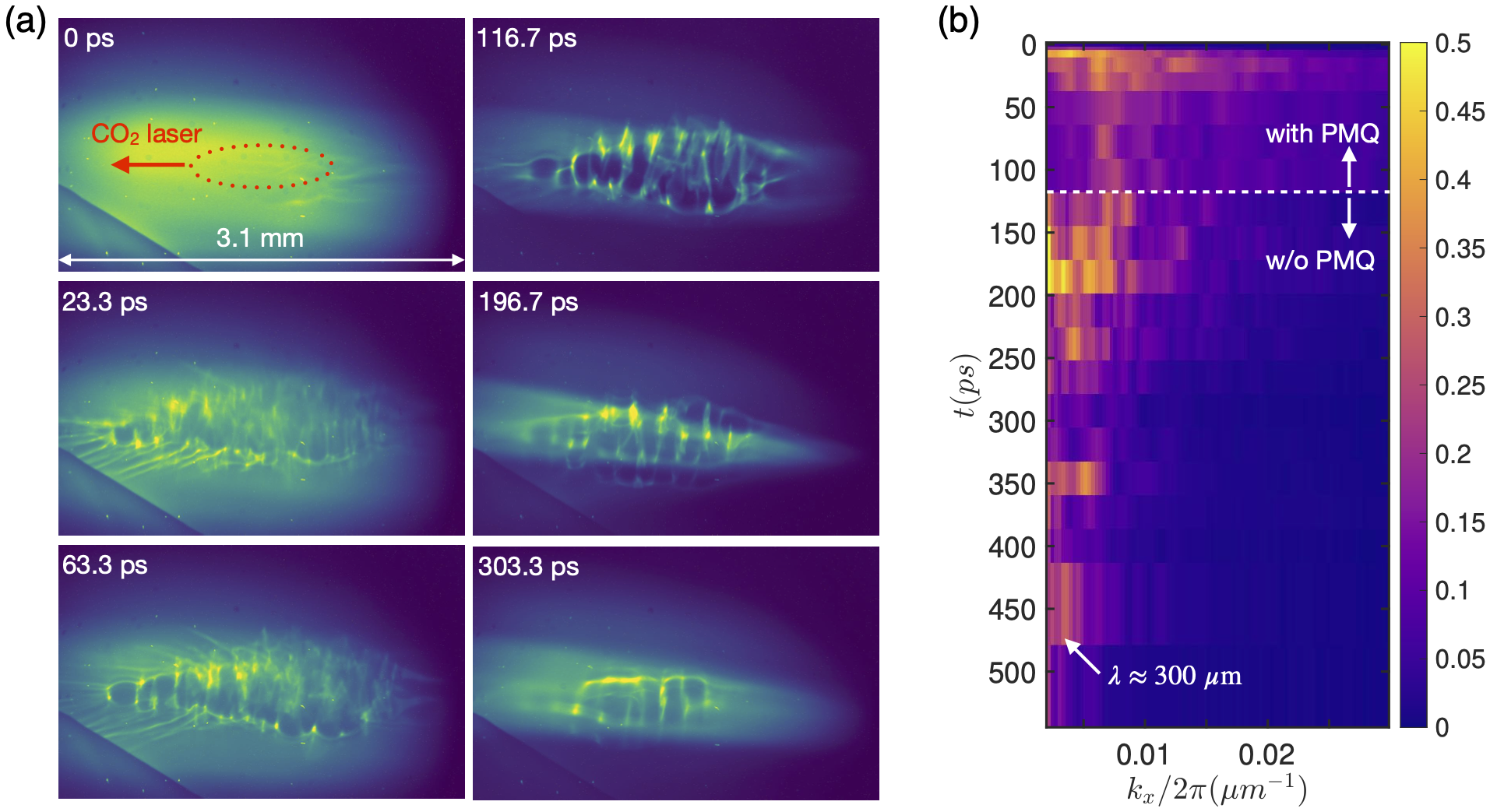
Fig. 4: The magnetic field structures are shown to be quasi-static and persist for hundreds of picoseconds, long after the initial instability has saturated.
Impact: A New Window into Fundamental Plasma Physics
This series of work, published in several high-profile journals, establishes OFI plasmas as a robust and reliable platform for studying the fundamental kinetic instabilities that govern plasmas throughout the universe. For the first time, we can create plasmas with precisely known initial conditions and watch them self-organize, providing clean, unambiguous data to benchmark kinetic theory and simulations. This opens a new window for exploring the origins of cosmic magnetism and other energetic phenomena in a controlled laboratory setting.
Related Publications
- C. Zhang, et al. “Self-organization of photoionized plasmas via kinetic instabilities.” Reviews of Modern Plasma Physics 7, 34 (2023).
- C. Zhang, et al. “Mapping the self-generated magnetic fields due to thermal Weibel instability.” Proceedings of the National Academy of Sciences 119, e2211713119 (2022).
- C. Zhang, et al. “Measurements of the Growth and Saturation of Electron Weibel Instability in Optical-Field Ionized Plasmas.” Physical Review Letters 125, 255001 (2020).
- C. Zhang, et al. “Ultrafast optical field–ionized gases—A laboratory platform for studying kinetic plasma instabilities.” Science Advances 5, eaax4545 (2019).